
Question: There are constantly new nutrition fads cropping up on the internet – what do I believe?
Answer:
That is a great question.
Nutrition fads are everywhere. Suddenly everyone is cutting out carbs, adding cottage cheese to everything, or coining new terms like fibermaxxing.
The internet, especially social media, loves to broadcast the latest and greatest in nutrition advice and people are always coming up with something new or recycling an old idea.
It can be hard to know what to believe.
Especially because sometimes there is validity to a fad. Just because something hits Tik Tok before the research is done, does not mean the advice is not useful. But it is also true that sometimes Tik Tok fads are just that – unhelpful, distracting, money-sucking fads.
How do we know what is valid advice and what is bogus? It can take a little work to decipher the difference. Today, I am going to share my favorite tools for sorting this out. I call it my BS spotting toolbox.
Before we dive into this toolbox, let’s take a quick step back and understand where we are in history.

Nutrition Fads Are Nothing New
Nutrition fads come and go and they have been coming and going for centuries. This is not new. We have long been trying to fix our health, our bodies, and our souls with the latest and greatest in nutrition.
One of the earliest recorded nutrition fads was the recommendation that athletes and warriors eat deer liver and lion heart to increase their “bravery, speed [and] strength”. I suppose the act of obtaining a lion heart likely would develop bravery, speed, and strength, but not as a result of eating the heart.
The 1800’s are especially full of nutrition fads including drinking a water and apple cider vinegar concoction, chewing food to a pulp (called Fletcherism), and the first recorded low-carbohydrate diet. This was also the era of the “snake oil salesman”, men who sold fraudulent cures (often in the form of herbs or supplements) to unwitting customers.
In this century, fads often carried a spiritual component, tying together moralism and food consumption or restriction.
While the medical system has progressed greatly since the 19th century (thank-goodness we are no longer bloodletting in response to a fever), it seems that our nutrition advice is still prone to the peddling of snake oil salesmen. And these snake oil salesmen (aka social media influencers) have been given an outsize platform on social media. The internet and social media have accelerated the spread of information, including misinformation.
In addition, nutrition continues to carry moralism vibes. While many people have discarded a spiritual component to food, nutrition fads often give off a “I am a better person if I eat more kale and lose weight” vibe.
And now we also have to contend with AI. According to The State of AI Traffic Report released by Human Security, there is now more AI traffic on the internet than human. And they note that “The question is no longer whether traffic is automated. It is whether a given interaction is trustworthy, regardless of whether it comes from a human, an AI agent, or an agentic browser.”
In addition, the unregulated supplement industry drives a trillion-dollar (yes, trillion!!) wellness industry that just loves capitalizing on a new fad.
It’s a lot – all the information, the speed of the changing information, the insidious nature of so much information being promoted by people with a vested money interest, and now AI joining in the fray.
Aside from taking a daily cold shower to help cope with the mess of nutrition information online, here is how I approach the world of nutrition fads.
I am trained in nutrition, how the body works, and understanding research. My approach takes a little time, but it beats falling headlong into the muck of nutrition misinformation. This is how I assess new nutrition information to identify whether it is bogus or if I too should put cottage cheese in my eggs.
BS Spotting Toolbox: 5 questions to ask yourself about nutrition advice

First…Who is the source?
The source matters. When I hear of a new idea, one of the first things I do is look into who is saying it. What is this person’s training and background? Anyone can say anything they want on the internet with very little repercussions for false information.
The only profession that receives regulated training in nutrition is registered dietitians. Registered dietitians have four years of undergraduate school, two years of graduate school, and one-year of supervised practice – all focused on nutrition. To call ourselves registered dietitians, we also have to complete a standardized exam, annual ongoing education, and in many states, obtain a license. All of this is regulated, which is to say that everything is held to a standard that is monitored.
Dietitians sometimes call themselves nutritionists, but nutritionists are not registered dietitians. The term ‘nutritionist’ is not regulated. Someone who says they are a nutritionist may have completed a one-month course OR they may have gone to grad school. If someone calls themselves a nutritionist, it is important to understand their educational background, whereas when someone is a registered dietitian, you can trust that they received the aforementioned education.
Granted, someone who is not a registered dietitian may have valuable ideas to contribute to the field of nutrition, but the reality is that the body is complicated and research is complicated and without the background knowledge that a dietitian has, it is easier to fall for shit.
To be honest, even if a registered dietitian is telling you something new and unusual, I encourage you to side-eye it. Sometimes I even stop and side-eye myself. It is a good idea to check up on all new information.
What about doctors and nurses? Doctors and nurses are super smart people with a lot of education, particularly about how the body works. I do not want to downplay that. But the reality is that they get very little nutrition education. In fact, most medical schools do not require any nutrition education at all (source).
Sometimes doctors and nurses (and other professions) receive additional education in nutrition and they become well-versed in nutrition. But it is not a given. Very few health professionals are well educated in nutrition other than dietitians. This makes it easier for them to fall for shit and to promote unsound nutrition advice.
Another good question to ask is whether this person is receiving compensation in some way for peddling their advice. Are they selling supplements to cure the problem? When someone receives money for promoting an idea, it immediately creates an internal bias and they are less likely to recognize when they are sharing bad advice.
Let’s use the recent fad of meal sequencing as an example. A huge advocate for this approach to eating is the Glucose Goddess.
Who is the Glucose Goddess and what is her background? Jessie Inchauspé is a biochemist, trained as a mathematician, and worked as a geneticist. So yes, she has a background in science and understanding the body and research studies. She is likely super smart. And her work absolutely contributes to our understanding of glucose and how it impacts the body.
In fact, I like a lot of her work and have the tendency to eat in the way that she recommends.
BUT there are a few things to be aware of.
First, she is hyper-focused on one area of nutrition – blood sugar control. Her information needs to be taken into context of the wider lens of nutrition in general and the body as a whole. She also does not seem to take into account the tendency for people with blood sugar issues to develop eating disorders.
Second, she is selling us stuff. Her entire livelihood depends on glucose control being THE most important thing to pay attention to in our diets. That’s biased. Plus, her protein powder costs twice as much as simply eating a piece of chicken.
All that to say, it’s important to understand someone’s educational background and to recognize when someone’s nutrition advice needs to be taken with a grain of salt.

Second…Is the evidence anecdotal?
‘Anecdotal’ simply means that it is based on someone’s experience. For example, if someone purchases a glucose monitor, starts tracking their glucose response to food, and then tells you how their body is impacted by different foods, this is anecdotal evidence. It is evidence that consists solely of someone’s experience.
Stories are powerful. They are informative and are a great place to start in studying a new phenomenon in health. But people’s stories are not medical advice. We all have different bodies, different genetics, and different lives. Plus, it is really easy to misinterpret something that happens to us.
For example, nearly a decade ago, I started having reflux symptoms. I looked at my diet and realized I was eating more dairy than usual so I cut dairy out of my diet and my symptoms stopped. It would have been easy to stop there and determine that dairy caused reflux and I should avoid it. In addition, I could have gone a step further and started advising people to avoid dairy if they have reflux.
Instead, I gave it a little time and then reintroduced dairy and I was fine. No reflux symptoms. Was dairy actually the problem? Was something else going on in my life that was causing physical symptoms? Was I eating something else that I then stopped eating that was causing the problem? It’s hard to know. But this sort of thing happens all the time. The danger is in pretending we know exactly what happened based on our experience.
This is why randomized, double-blind research studies are important and how the medical field has gone from bloodletting to using medication in response to illness. This is why it is no longer common for children to die young, why we have medicines that prevent strokes, and how we can cure some cancers that used to be deadly.
Randomized, double-blind research helps pinpoint what is actually happening in the body and how medicine can help the most people. This type of study is difficult for nutrition because we do not eat in a vacuum. It is sometimes incredibly difficult to narrow in on what is truly effective in the world of nutrition. BUT just because something is hard does not mean it is not important. It just means we side-eye MORE nutrition advice, NOT less.
All those lovely Instagram people using glucose monitors and telling us how their body responds to different foods are using anecdotal evidence. Again, it is a good place to start. But this is not the place to stop.
The next question to ask yourself is…

Third…What does the actual research say?
This one can be a bit more difficult. Research is often complicated, dry, and difficult for the average person to interpret or access. This is part of why misinformation is so common. It is easy to read a few lines of a research article and promote these as gospel, but it is important to pay attention to the research article as a whole, understand how the research was done, by whom, and take it into context of the bigger picture. This takes a LOT of background knowledge and the basics of understanding research terms and how research is done.
For the average person, it’s a little like an English speaker who does not know Spanish, going to Spain. There are some words that are the same in both languages so it is possible that the English speaker will understand some of what a Spanish speaker says, especially when combined with gestures and tone.
But the reality is that unless the English speaker learns Spanish, they will not understand most of what is said in Spanish. If they learn the language, then they will start understanding and pick up on nuances that they previously could not. It takes training.
The idea that ‘everyone does their own research’ on every topic these days is a little like saying ‘I speak all languages’ when you only speak one.
The fact that everyone cannot “do their own research” does not make anyone dumb. It is simply a byproduct of a world with a lot of information. Stick with me here.
This is true for every profession. If you are a road builder or a farmer, you would laugh at me if I told you how to build a road or raise pigs based solely on my internet research. People who spend their lives building roads and farming simply understand it better than if I ‘did my own research’. Their practical experience and training (whether hands-on training or formal training) trump my internet research hands-down.
This is not to say you are not an expert in your body and your life – you absolutely are. When I work with a client, I rely heavily on their self-knowledge combined with my knowledge of nutrition to figure out what works best for them. And sometimes clients bring an extensive amount of knowledge on a nutrition topic to the table. I value that. But I do my best to ground their knowledge in my broader base of nutrition knowledge and how the body works.
Back to nutrition information – when I encounter a new topic, I immediately ask – what does the research say? For example, when I first heard about meal sequencing – the idea that we should eat our food in a specific order (fiber, then protein, then carbs), I immediately dove into research articles on this topic.
I first went to Pub Med and looked up all the articles I could find. Most of the articles were topic adjacent. This means they looked at blood sugar control and the impact of different foods on blood sugar control, but they did not answer my question: Is there benefit for an adult with or without diabetes to eat food in a specific order?
I eventually found one research article that was a systemic review. A systemic review is the best kind of research because it looks at all the research that has been done and draws conclusions based on this. Although side note, it took me weeks to get my hands on this article because it was pay-walled through most sources.
Reading through an article like this highlights the nuance of how the body works. The message around meal sequencing comes across as simplistic on social media, but the reality is that there is a lot to keep in mind when it comes to how food impacts the body.
Essentially, this systemic review shows that meal sequencing has promising effects for blood sugar control. Although current research does not take into account different ethnicities, high fiber carbohydrates, or assess for long term impact. Nor does it show any benefit for perceptions of hunger, appetite, or satiety.
In addition, this research did not take into account whether meal sequencing contributes to eating disorder behaviors.
Reading research always gives me perspective on the latest fad. Rarely is new nutrition advice as straight-forward or as black and white as social media makes it sound. It is always important to understand the actual research, whether through reading it yourself or finding a trustworthy translator.

Fourth…Is it the placebo effect?
The placebo effect is POWERFUL. This means that something can work even if it does not work. Simply believing something can work, can make it work. But that does not mean believing it will work if effective for everyone. The placebo effect is not a well understood phenomenon. I wish we did so that we could harness this power more effectively.
But that does mean that anecdotal evidence is chock full of placebo effect. This is why randomized, double-blind research studies account for placebo effect.
Because placebo effect exists, this means that one person’s truth is not always someone else’s. People’s stories are not to be trusted as nutrition advice.
Fifth and final point…. Ask yourself – is it weird?
This is not a hard and fast rule. Sometimes weird things work. Like swallowing a poop pill can change your microbiome for the better. Weird, gross, but effective.
But I bring this up because so many nutrition fads promote disordered behaviors and a disordered relationship with food.
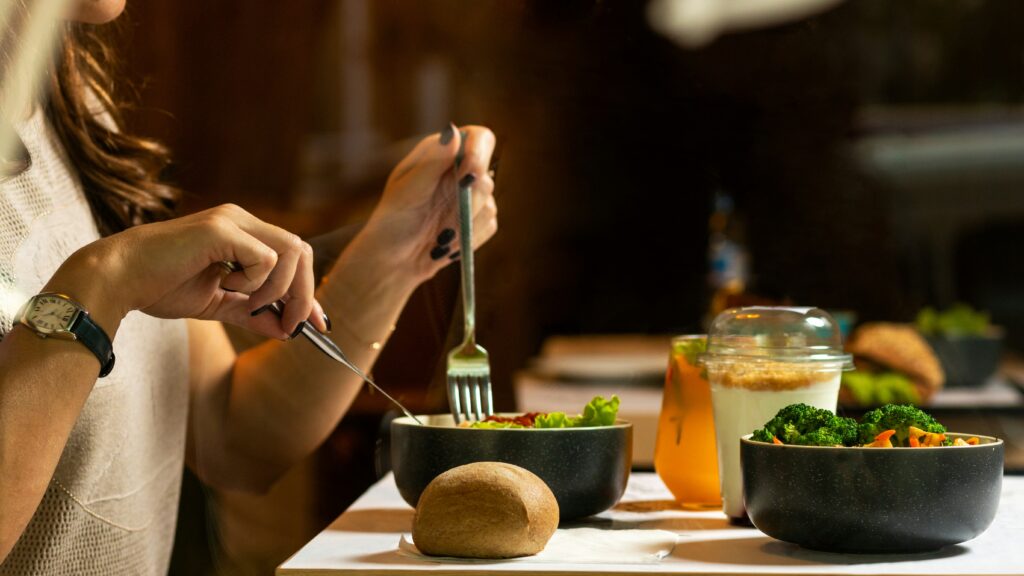
For example, meal sequencing. If you find yourself buying a delicious bowl of food, but then sorting the rice, the meat and the veggies into neat little piles when the dish was meant to be eaten all together, then I am sorry but that’s weird. Don’t do that.
Also, it’s a little weird to put protein powder in your coffee. And it’s a little weird to feel like you have to do calf raises after eating a cookie. (Looking at you Glucose Goddess.)
All that to say, oftentimes nutrition fads are benign. If you want to eat a green salad before most meals, that does not have to be weird. But don’t get stuck on it. And do not promote it as a cure all.
Recognize that food matters, but it is not the only thing that matters. And it is not the only player when it comes to physical health. Our genetics, economic status, mental, emotional, and social health matter too.
The Bottom Line
In summary, my approach to new nutrition information and the rotating door of nutrition fads is to approach everything with a grain of salt, believe nothing until proven valid, read the actual research, and then adjust my stance accordingly.
I do my best to remember the big picture, keep in mind what my goals are, and remember that the basics have not actually changed that much. Move your body, eat your protein, vegetables, fruit, carbs, and fats in moderation, enjoy the people and the food around you, and sit back and enjoy the ride – it will be over before we know it.
More Resources to Debunk Nutrition Fads
If this topic interests you, here are a few of my favorite Instagram resources that debunk fads:
𝘽𝙍𝘼𝙎𝙃𝙣𝙪𝙩𝙧𝙞𝙩𝙞𝙤𝙣 | Dietitian (@brashnutrition) • Instagram photos and videos – James is a wealth of knowledge. He shares the facts and myths of the nutrition world in a simple and direct manner. Here is his post on “Social media literacy is health literacy”
Jessica Knurick, PhD, RDN (@drjessicaknurick) • Instagram photos and videos – Jessica combats politically driven misinformation with evidence and common sense.
Food to Fit Nutrition, Non-Diet RDs (@foodtofit_nutrition) • Instagram photos and videos– This is a group practice based out of Canada that offers trustworthy information on a diverse range of topics that are often confusing. Here is their post on “Spotting Nutrition Misinformation”
Caroline Thomason (@dietitiancaroline_) • Instagram photos and videos– Caroline share practical advice and has an excellent post on “How to spot bad nutrition advice”