



This blog post is part of our monthly Nutrition Advice Column. Feel free to submit your questions to [email protected] or complete the form below.
Question: What should I eat and how much should I eat?
Answer:
I hear this question all the time. In our current food culture, it is common to feel confused about food, nutrition and what your body needs. This confusion can be overwhelming. We are faced with eating every day, several times a day. Making food choices can be tiresome in the best of circumstances, but being confused about what to eat adds a level of frustration that can feel unbearable.
I have had many clients sit in front of me, nearly in tears over what to eat. They are exhausted and just want to be told what to do. I feel a deep empathy for these clients.
This confusion makes sense because we often get mixed messages both from diet culture and nutrition research.
I will dive into ‘what to eat and how much to eat’ in just a bit, but first, let’s explore the cause of this deep-seated uncertainty around food.
Let’s start with diet culture:
Diet culture messes with our self-trust. Diet culture tells us our bodies should look a certain way even though the so-called ‘ideal’ is impossible for most people. This emphasis on body size is connected to the false idea that only smaller bodies are healthy (read more here).
Even people who are genetically pre-disposed to meet the diet culture ideal often feel like they need to lose weight or change their body in some way. No matter someone’s size, diet culture will tell them it is never enough.
The internal drive to make our bodies smaller often leads to dieting. A host of diets promise that they contain the answer and will shrink our bodies. These diets tell us to cut out carbs, eat less bananas or less fats or just simply eat less, less, less. Or eat MORE protein. (No wait, ONLY eat protein.)
Regardless of the diet (and there are SO many), they often start messing with the cues we were born with to understand our hunger, fullness and cravings.
This can lead us to doubt our appetites and cravings. We start battling our body and stifling our trust in ourselves. I have had many clients tell me that after years of dieting, they no longer know what to eat or how much to eat. They lose trust in their body and can sometimes no longer sense cues at all. I see a direct correlation between dieting and confusion around food.
Now, let’s explore why nutrition research causes confusion:
Nutrition research drives confusion because it changes. For example, eggs got a bad rap for years, but more recently headlines highlight the benefits of eggs. Eggs have a fair amount of dietary cholesterol (aka cholesterol found in food, not the lab you get from your doctor), so when our understanding of dietary cholesterol changed, so did recommendations on eggs.
It turns out that cholesterol in food has less impact on cholesterol in our bodies than we thought, although the reality is that research is still mixed when it comes to eggs.
This change in research happens routinely, making it hard to know what to believe.
But there is no conspiracy and these changes are not meant to cause confusion. Shifting recommendations are simply the nature of nutrition research.
The gold standard in research is a double-blind placebo-controlled study. This type of study consists of two groups of people. One group is given the ‘treatment’ and one is not, but neither know if they are receiving it.
This type of study is impossible with food for multiple reasons. First of all, creating a ‘blind’ study is difficult because people typically know what they are eating. Second, people do not eat one nutrient at a time making it difficult to isolate the impact of one nutrient. In addition, foods interact with each other in a variety of ways. Not only is it difficult to isolate these interactions, it is not particularly helpful to do so because we do not eat that way.
Let’s go back to our example of eggs. Eggs contain cholesterol, but they also contain protein, omega 3’s, vitamin A, phosphorus, selenium, B vitamins, vitamin D, calcium, vitamin E, zinc, choline, and antioxidants (source) Eggs contain varying amounts of these nutrients depending on what the chicken eats and whether it can run around outside. Studying cholesterol alone is difficult because eggs contain many other nutrients that affect how the body responds to this food.
Not only that, but people’s bodies respond differently to dietary cholesterol from eggs depending on their genes.
In other words, studies showing the harm or the benefit of eggs because of cholesterol are complicated.
These factors make nutrition research difficult and the conclusions tenuous. In addition, our health is impacted by a wide variety of environmental, social, and genetic factors (not just the food we eat), so this adds another layer of complexity. Two people may eat the exact same number of eggs every day, but a host of other factors will impact whether or not they get high cholesterol as a result of these eggs.
It makes sense to me that our understanding of food changes over time as our research continues to develop. I am not mad about the research changing. But it is important to take nutrition research, especially about individual nutrients, with a grain of salt. (Or not, depending on what current research says about salt.)
So what is the answer? How much should we eat and what should we eat?
First of all, there is no should, with the exception of yes, you should eat. You are under no moral imperative to eat a certain amount or to eat certain foods. Let me start with that.
And let me say it louder, in case it is hard to hear. Eat whatever you want. No one should make you feel like there is a ‘good’ or ‘bad’ food. Food is just food. Keep morality out of it.
The first goal is always TO EAT. The second goal, if possible, is to include a variety of food groups.*
The body functions best when we eat from every food group although these exact quantities and specific foods vary according to each person.
Here are the food groups to keep in mind, although please know that each category contains a wide variety of foods. I will provide a few examples in each group, but these lists are just the tip of the iceberg on options.
Also please know that these foods are not listed in order of importance. We need all of these equally. Our bodies function best if we include ALL of these groups.
CARBOHYDRATES/GRAINS
What they are: bread, pasta, rice, farro, oats, corn, legumes
What they do: Your body runs on carbohydrates. Moving throughout your day, paying attention to your boss, talking to your child – you can do all of these things courtesy of carbohydrates. You also get B vitamins and fiber from grains although the amount depends on the food itself.
You might need more if: You’re sluggish or having trouble concentrating.
PROTEINS
What they are:
- Animal: chicken, beef, fish, dairy, turkey
- Plant: tofu, beans, soy, nuts, seeds
What they do: Your hair, your muscles, and literally nearly every single process in your body needs protein. If you cut yourself, you need protein to help heal. If you get sick, you need protein to make antibodies. If you exist in a body, you need protein to keep your muscles intact.
You might need more if: You are feeling weak, tired, or you are losing a lot of hair.
FRUIT
What they are: mangoes, apples, grapes, bananas, cantaloupe, papaya
Fresh, frozen, canned – it all counts.
What they do: Fruit gives us fiber, vitamins, minerals, antioxidants, and phytochemicals (aka something in plant food that we are still researching). This combination of nutrients has been shown to lower risks of chronic disease and helps us have regular bowel movements.
You might need more if: You have irregular bowel movements or need a wider variety of vitamins and minerals.
Fun Fact: If you find yourself with scurvy, you likely need to add some fruit. I know it sounds bananas. Scurvy was something sailors got after weeks at sea when they couldn’t get their hands on fruit. But scurvy is weirdly on the rise. So eat some fruit occasionally and avoid this old sailor’s disease.
VEGETABLES
What they are: spinach, broccoli, carrots, potatoes, peas, avocado, corn
Fresh, frozen, canned – it all counts.
What they do: Vegetables are the fraternal twin to fruit. They give us fiber, vitamins, minerals, antioxidants, and phytochemicals, but a slightly different variation than what we get from fruit.
You might need more if: Same story as fruit. If you find yourself regularly constipated or getting lots of colds, consider bumping up your vegetable intake.
FATS
What they are: fish, nuts, seeds, butter, oils, dairy
What they do: Fats keep our brains in business and give us the ability to have babies. They help the carbs in our diet to release slowly to prevent sugar crashes, and they give us that happy, satisfied feeling after a meal. Oh, and they keep our hair and nails shiny and strong, just like protein.
You might need more if: You get hungry pretty often or have dry skin (although I am not talking the winter dryness that those of us in the Northeast experience). You may also need more fats if you have trouble conceiving.
These five food groups help us to categorize foods, but the reality is that many foods contain some of several groups. For example, fish contains both fats and protein. Sweet potatoes and corn contain fiber and are considered vegetables, but they also have carbohydrates so they act like a grain in the body. I could go on, but suffice it to say, these categories are not rigid nor do we need to eat as such.
If you want to read more about these food groups, feel free to check out this handout here.
In the US, we often go through phases of being alarmist about fats, carbs, or even certain fruits and vegetables. But then we flip the script for a period of time. Protein, for one, is having its moment. You only need to look at the most recently published dietary guidelines to recognize that protein is currently a rockstar.
There is a bit of a fuss about current dietary guidelines and the changes from previous years and I am not going to get into that here (although there is much that could be said), but the reality is that overall, recommendations have not changed that much. These five food groups are still the foundation for a balanced diet.
And the truth of the matter is that most of us get enough protein and some types of fats and most of us, including some dietitians (aka me), could stand to eat more fruits and vegetables (source).
Quick word on dairy: Depending on the source, dairy is also considered a food group. I did not include it because dairy falls into three of the groups – protein, fat, and carbohydrate. While dairy is an excellent and cheap source of all of these nutrients (plus many others), you do not need it to meet your nutritional needs.
And what about water you might ask? Yes, drink it. Your body is more than 50% water. It will love you for drinking water.
So back to the question of – what should I eat and how much?
Eat foods from a variety of the above groups. I find that the Health Eating Plate is a helpful visual (see image below); however, keep in mind that the goal is to include these food groups throughout the day, though not every meal needs all of them.
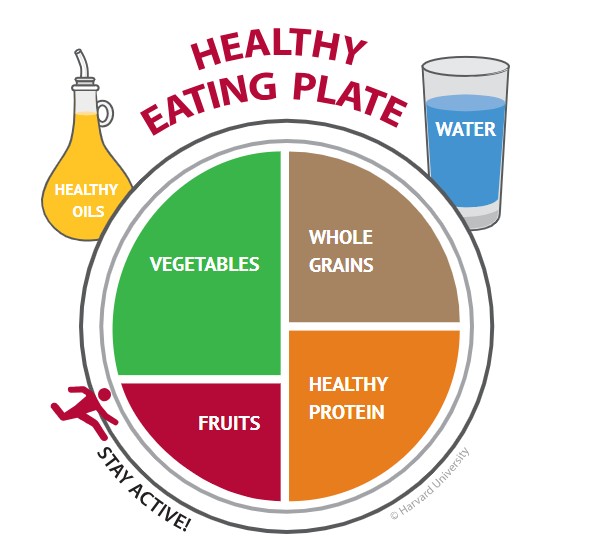
To make this simple, I tell people – pick your protein, pick your carb, and then think about having a fruit or a vegetable with each meal. But again, many foods fit into multiple categories so the lines get blurred and that is okay. Most people eat fats incidentally through cooking with oil or butter, or from eating protein and dairy, so most people do not need to pay close attention to this group**. Do what you can and don’t overthink it.
I will share a few examples from my own life to give you a sense of this, but again, please know that these examples are NOT prescriptive:
Breakfast: savory oatmeal with two eggs and sauteed veggies (contains carb, protein, fat, veg)
Lunch: ham & cheese sandwich, clementine and chips (contains protein, carb, fat, fruit)
Dinner: roasted tofu with rice and broccoli (contains plant protein, carb, veg; contains fat when I roast the tofu with oil)
Snacks: trailmix, string cheese, grapes, cookie (contains protein, carb, fat, fruit)
It might seem expensive and time-consuming to ensure you are getting all the food groups. Perhaps. Like Kendra Adachi points out – it is hard to have cheap, quick and balanced; you often have to choose two out of three. I am inclined to agree with her.
For example, balanced meals can be quite cheap, but you typically have to put the time in to make it from scratch. Quick, balanced meals are not often cheap. And quick, cheap foods are oftentimes lacking in variety. This is, unfortunately, the nature and difficulty of our current food system and food culture.
Until someone opens up a community dining hall on every corner where I envision we can all go to eat inexpensive, delicious, balanced meals then we are going to have to put up with the trade-offs.
And it is okay to eat what you like.
If you prefer plant protein, stick with plant-protein (although you may need vitamin B12 supplementation so be sure to talk to your doctor or dietitian about this).
If the only fruit you like is apples, then only eat apples.
If you like pasta, but despise bread – that’s fine. Eat the pasta, ditch the bread.
Your first goal is to eat, then your secondary goal is to include a variety of food groups. Food is not moral or immoral. Save your virtuous energy for actual matters of the soul.
And how much should you eat? As much as you need.

Eat several times a day. Eat until you are satisfied. Most people need to eat every 3-4 hours to maintain energy. If you are tired throughout the day despite adequate sleep, you may need to eat more often or include more variety in your food groups.
You may be wondering why I am not giving exact amounts. After all, nutrition information is littered with pictures of quantities and plates showing serving sizes. I am not trying to withhold important information from you.
The truth is that how much you need is personal and dependent on so many things. It depends on your body, your muscle mass, your activity level, how much you had to eat the day before, your metabolism, whether you are pregnant, nursing, or postmenopausal, and your gut microbiome.
And the truth is that diet culture would like you to think that you need an expert telling you exactly how much to eat. Because if you know exactly how much to eat, then you will be able to shrink your body and fulfill societal expectations for what a body ‘should’ look like. But it’s a lie. When you outsource your appetite, you lose touch with your body.
I want you to learn to trust your body, to understand what it is telling you, to listen to its needs and to allow it to take up space in the world.
I want you to live connected to your body, to embody your body. Our bodies are how we experience this world. They are how we hear the muffled quiet of the first snowfall, how we smell the scent of spring blossoms, how we feel warm sunshine on a balmy day, and take in vibrant fall colors. When we disconnect from taste and our appetite, we run the risk of muting other senses too. And in turn, muting our experience of being human.
There is no ‘exact amount’ for every person. I want you to be able to listen to your body, understand what and how much it needs and respond accordingly. Allow your hunger to tell you when and how much to eat.
Where to go from here?
Start by focusing on eating more consistently. This is always the first step. Some people come to me wanting to tweak the types of foods they eat, but their eating patterns are irregular. You cannot change what you eat if you are not eating. So, start with consistency.
When you have consistency down, then you can pay attention to food groups. But keep this simple. Start with one food group at a time and work your way through them. Check out last month’s blog post about how to make changes that stick.
If you struggle with tuning in to your hunger, consider checking out the hunger-fullness scale. Review this scale before and after eating and it will help guide you to understanding your body’s cues. This resource also helps you think about the different types of hunger you may experience such as emotional eating.
What if your body mistrust runs deep? You would likely benefit from working through Intuitive Eating principles. Most people are born with the ability to tune in to how much they need to eat, but a host of things, especially dieting, can interfere with this. Intuitive Eating helps you get in touch with those in-born signals of hunger/fullness and can help you trust your body again. Check out the resources below for ideas on where to get started with Intuitive Eating.
What if you still feel confused and overwhelmed? That’s completely normal. Diet culture tentacles are long and it is easy to freeze when faced with a lot of information. Just pause, take a deep breath, then pick ONE thing that sounds doable.
Two important side notes: There are many health conditions that warrant a specific diet such as celiac disease, diabetes, and kidney disease, to name just a few. If this is the case for you and you do not know what to eat, please consider meeting with a dietitian for personalized advice. The above recommendations are general guidance for someone without a condition warranting a specific diet.
In addition, if you struggle with emotional eating, raging cravings, or the desire to endlessly whittle down the amount you are eating, or if medications you take interfere with your appetite, then you may also benefit from meeting with a dietitian.
In summary, eat food. Eat a variety and eat as much as you need. If this sounds impossible, get help from a certified intuitive eating counselor. There is no need to struggle alone. You can re-awaken the internal cues you were born with and you can learn to trust your body again. Food does not need to be complicated or overwhelming. We have enough to worry about. Food does not need to add to the burden. Food should serve you and give you the energy you need to live your life, not the other way around.

*Eating a variety of foods is not available to everyone, particularly if someone has food-insecurity. This also may not be available to someone if they are neurodivergent. Please be kind to yourself if you find yourself in these shoes and struggling to eat a variety of foods. Remember, the goal is to eat. Fullstop. If you want help, consider reaching out to a dietitian. Dietitians are great at finding creative ways to incorporate food groups and at finding local resources.
**Some people consume primarily fat-free dairy and protein and avoid cooking with fats so they may need to intentionally add in fat. Some people could also benefit from including more unsaturated fats such the fats found in fish, nuts, and some plant foods such as avocado. If you are uncertain about your fat intake, consider talking to a dietitian.
Want to meet with a dietitian?
Reach out to your primary care doctor and ask for a referral to see a dietitian. Insurance often covers these visits. If insurance does not cover this, then find a private practice dietitian who offers reasonable self-pay rates.
Here at Eat Well Collective, we take most insurances and we offer an excellent self-pay rate. Feel free to get in touch here or email us [email protected].
Want to learn more Intuitive Eating?
Here are a variety of options to pick from:
- Read or listen to the Intuitive Eating book. This knowledge is revolutionary.
- Take a deeper dive and work through the Intuitive Eating Workbook.
- Level up and work with a dietitian who is certified in Intuitive Eating as you go through the workbook. Find one in this online directory or feel free to reach out to us at Eat Well Collective – I am certified in Intuitive Eating and I get really jazzed to work with clients on this stuff.
- Check out The Full Plate – An Intuitive Eating hub that offers support, resources, and a community for people seeking to change their relationship with food.
- Check out the Way app – this app is a hands-on guide to Intuitive Eating combined with cognitive behavioral therapy.
- Check out previous blog posts about Intuitive Eating:
I would love to hear your thoughts on this topic. Please do not hesitate to get in touch via email at [email protected]. In addition, feel free to reach out if you have a nutrition question that you would like answered in this advice column. All questions are posted anonymously.
If you would like to work directly with a dietitian at Eat Well Collective, feel free to contact us at here or schedule directly here.

